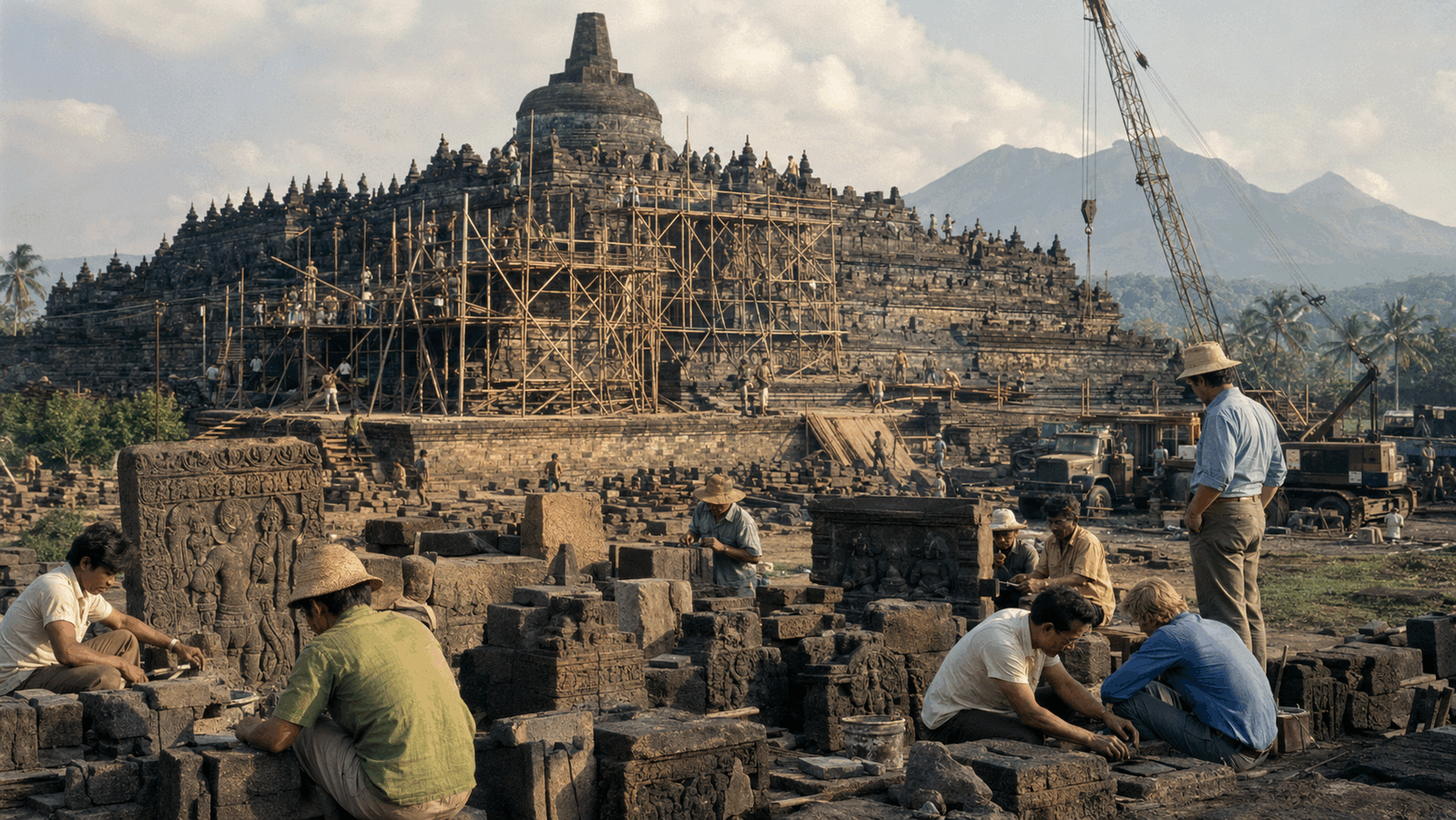
The Borobudur Restoration 1973 1983 project represents one of the largest cultural preservation efforts in Indonesia’s history. The restoration protected Borobudur from severe structural problems and helped preserve this ancient Buddhist monument for future generations.
Located in Central Java, Indonesia, Borobudur faced serious deterioration after centuries of exposure to weather, water, and environmental changes. A large international restoration program was needed to maintain the temple’s structure and historical value.
The Condition of Borobudur Before Restoration
After its rediscovery in the 19th century, Borobudur attracted attention from historians and researchers. However, the monument continued to experience significant preservation challenges.
Water became one of the biggest threats to Borobudur. Rainwater entered the stone structure and weakened parts of the terraces and foundations.
The growth of vegetation also affected the temple. Some stones became unstable, while several relief panels faced damage due to natural conditions.
Early restoration efforts provided important protection, but experts realized that a larger conservation program was necessary.
Visitors can learn more about this historical journey through Borobudur Temple history, origins, rediscovery, restoration, and legacy.
The Beginning of the 1973 Restoration Project
Major restoration of Borobudur began in 1973. The Indonesian government collaborated with UNESCO and international experts to develop a comprehensive conservation plan.
Project aimed to solve structural problems while maintaining the original design of the monument. Experts carefully analyzed the condition of each section before starting restoration work.
The restoration team documented thousands of stone blocks. This process helped workers return each component to its correct position after repair.
Restoration Techniques and Challenges
The Borobudur restoration project required advanced conservation methods. Workers carefully removed sections of the temple to repair damaged foundations and improve drainage systems.
One of the main challenges involved protecting the stone structure from water damage. Engineers developed a new drainage system to control moisture and prevent future deterioration.
The relief panels received careful attention during the restoration. Experts cleaned and preserved the carvings while protecting their historical details.
The project also required cooperation between archaeologists, architects, engineers, and conservation specialists.
Completion of the Restoration in 1983
Borobudur restoration project was officially completed in 1983. The monument regained greater structural stability after years of careful conservation work.
Restoration successfully protected thousands of stone elements and improved the long-term preservation of Borobudur.
Project became an important example of international cooperation in cultural heritage conservation. It demonstrated how modern science could support the protection of ancient monuments.
UNESCO Recognition and Long-Term Preservation
Following the restoration, UNESCO recognized Borobudur as a World Heritage Site in 1991. This recognition highlighted the monument’s outstanding cultural and historical importance.
Today, conservation efforts continue to protect Borobudur. Experts regularly monitor the structure and manage tourism activities to reduce potential damage.
Modern preservation focuses on maintaining a balance between public access and heritage protection.
Travelers who want to explore this restored masterpiece can join a Borobudur Temple tour to discover its architecture, history, and restoration achievements.
Conclusion
The Borobudur Restoration 1973 1983 project marked a turning point in the preservation of Indonesia’s cultural heritage. Through careful planning and international cooperation, Borobudur was saved from serious structural damage.
Understanding this restoration history allows visitors to appreciate Borobudur beyond its beauty. Every stone, relief, and terrace reflects centuries of history and the dedication behind its preservation.
